
Eire Vacuum Services Blog
Soil Removal Sydney: When a Vac Truck Is the Right Call
Samantha manages enquiries, bookings, and the day-to-day business side at Eire Vacuum Services.
Soil removal is the job of getting excavated or built-up material off a site and to a facility that is lawfully allowed to take it. In Sydney it usually comes down to one question: can the material be carried out, or does it have to be lifted out? Dry soil at ground level with a driveway nearby is a skip bin or a labourer job. Wet, heavy, compacted or hard-to-reach material, particularly above ground level or behind a finished building, is where a vacuum truck starts to earn its place.
At Eire Vacuum Services we remove soil, slurry, roots and loose material with vac trucks across Greater Sydney. This article covers which trade the job belongs to, when a truck is worth paying for, what actually drives the price, and what the disposal side means for you as the property owner. It also includes photographs from a real high-rise planter box clean-out, during and after.
Key takeaway
If the soil is easy to reach, a skip bin or a landscaper is usually enough. If it is in a high-rise planter box, a rooftop garden bed, a tight courtyard, a basement, a podium level or a strata common area, a vac truck cuts down the manual handling, the mess and the disruption.
Who actually does soil removal in Sydney?
Soil removal is not one trade. Rubbish removalists, landscapers, excavation contractors and vacuum truck operators will all quote on the same pile of dirt, and they are not interchangeable. The right answer depends far less on the soil itself than on how the material has to leave the site.
| Option | Suits | Struggles with |
|---|---|---|
| Skip bin | Dry soil at ground level, close to a kerb or driveway, small to moderate volume | Wet or heavy material, and anything that has to be carried up or down a level |
| Labourer or landscaper | Small garden beds, light material, sites where a bit of mess is acceptable | Volume, wet material, and finished common areas that need protecting |
| Excavator or bobcat | Open ground with room to work and a clear route out to a truck | Confined spaces, elevated planters, and work near services or finished surfaces |
| Vac truck | Wet, heavy, deep or hard-access material, long hose runs, contained removal | Straightforward ground-level jobs where a simpler option already works |
Access and material type decide the method more often than volume does.
If you are not sure which of those the job belongs to, that is reasonable. The rest of this article is about telling them apart. If your choice is specifically between a skip and a truck, we go through that comparison in more detail in skip bin vs vac truck for soil removal.
When a shovel, skip bin or landscaper is enough
A vac truck is not the answer for every soil removal job. If you have a small garden bed at ground level, clear side access, dry soil, and only a few loads to move, a landscaper, labourer, ute, or skip bin is the simpler option.
We would rather be honest about that. Vac truck work becomes valuable when the access, volume, weight, water content, or site controls make manual removal inefficient or risky. If someone can safely shovel clean dry soil straight into a nearby trailer, that is not a job that needs an 8,000L or 10,000L vac truck.
When vac truck soil removal makes more sense
A vac truck is a truck-mounted vacuum unit that lifts material through a hose into a sealed tank on the truck. That makes it suited to awkward jobs where access is limited and the material needs to be contained. The truck stays in a suitable loading position while the hose is run to the work area, so the operator can pull material out of places barrows, machines, and skips cannot reach.
For high-rise planter boxes that means lifts, stairs, finished common areas, tight courtyards, underground car parks and limited loading zones stop being blockers. It also helps when the soil is wet, mixed with roots, holding water, or likely to create mess on the way out.
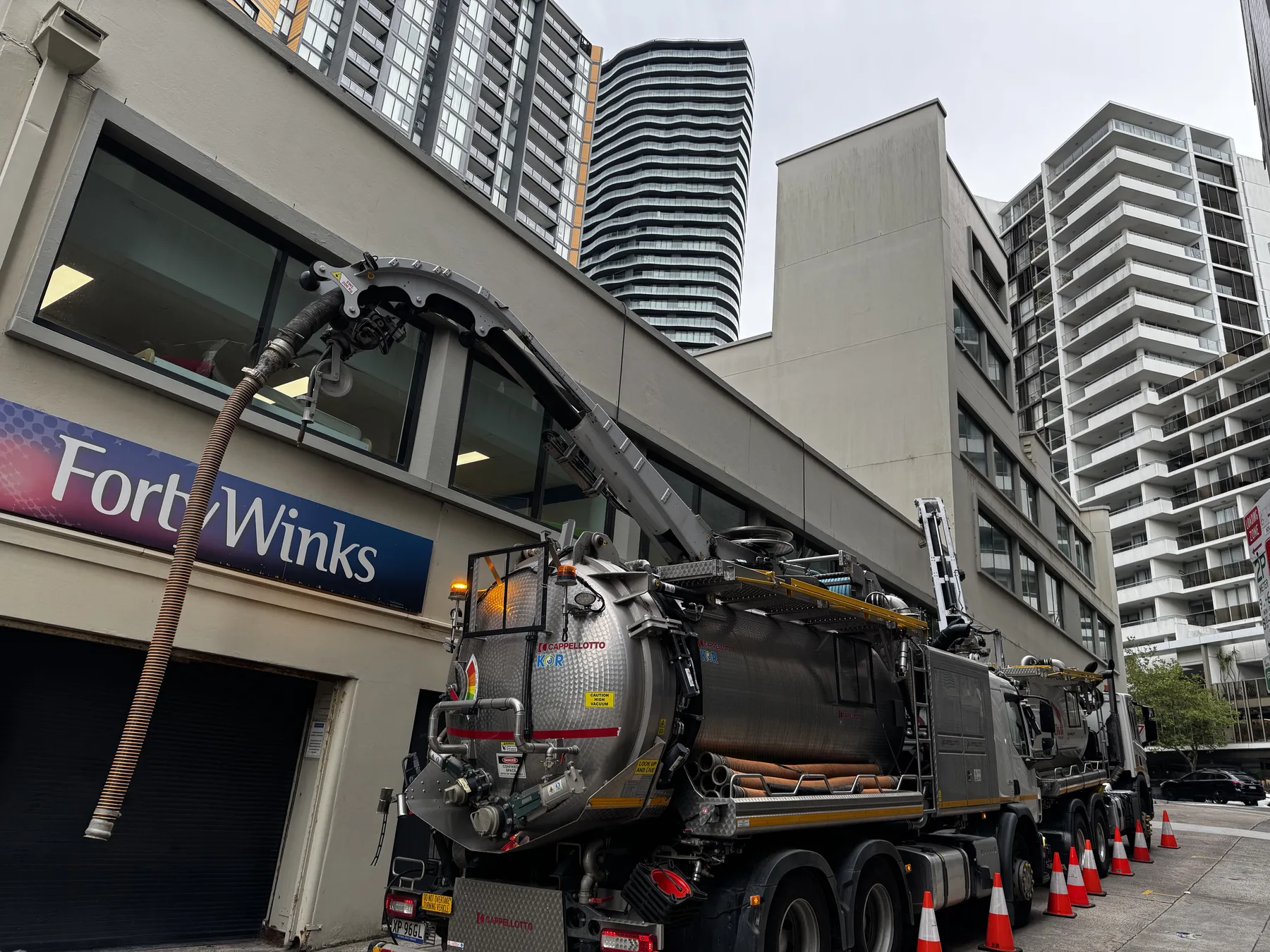
If the job also involves excavation near services, drainage lines, pits, or built structures, controlled vacuum work ties into our vacuum excavation Sydney and vac truck hire Sydney services.
Not sure which one you need?
Send the site details and we will tell you straight
Send photos of the material, the access route and where a truck could park. If a skip bin would do the job, we will say so.
Why hard-access soil removal becomes a problem in Sydney buildings
Planter boxes are often built into balconies, rooftops, podiums, courtyards, and common areas. Over time they fill with compacted soil, roots, failed drainage media, wet sludge, and organic waste. Removing that material by hand means buckets, barrows, lifts, stairs, protection boards, and a lot of labour.
The real problem is not the soil. It is how to remove the soil without dragging mess through the building or tying up access for longer than needed. When the material is wet or mixed, the job also overlaps with mud and slurry removal.
How we remove soil from a high-rise planter box
Every planter box clean-out starts with access. We look at where the truck can safely park, how far the hose needs to run, whether we need protection through common areas, what material is being removed, and where that material will go afterwards.
- Confirm truck access, hose route, working area, and site restrictions.
- Set up the hose run to reach the planter box or garden bed safely.
- Vacuum soil, slurry, loose roots, and debris into the truck.
- Protect the surfaces the hose crosses on the way in and out.
- Transport suitable material for disposal according to site and facility requirements.
A high-rise planter box clean-out, during and after
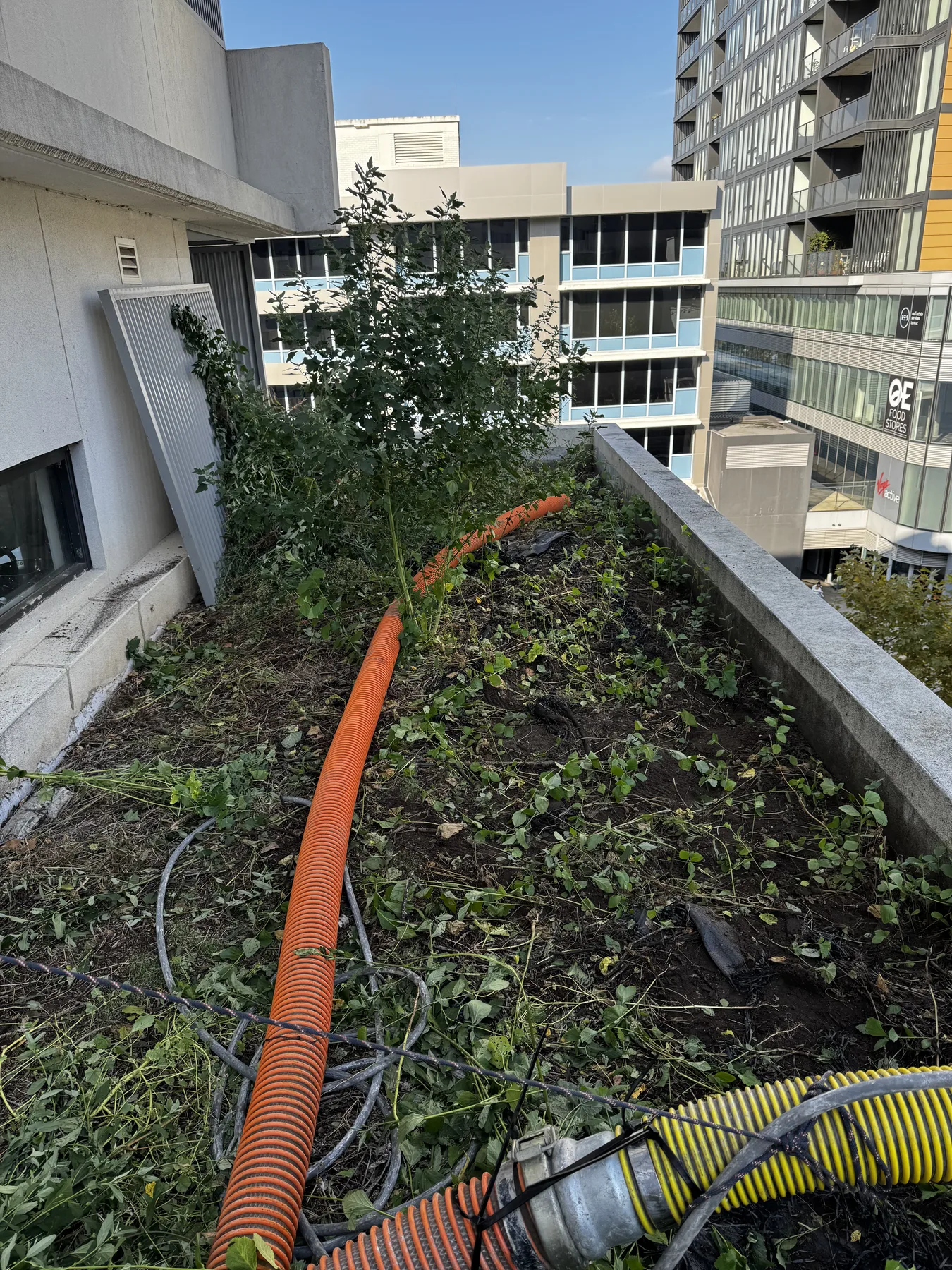
Every photograph on this page is from one of our own jobs. One of those photographs shows an overgrown planter bed with the suction hose already run through it: a long, narrow bed along the edge of an elevated terrace, hemmed in by the building on one side and a concrete parapet on the other, with office towers and apartment balconies looking straight down into it. The bed had gone to self-seeded shrubs and weed growth with a root mat through the soil. There is no vehicle access to a bed like that, and no route out for a barrow that does not go back through the building.
The orange suction hose in that photograph is the whole method. On that job we ran it the length of the bed from a coupling at the near end. The other end went back to the truck, out of frame. The two photographs below are from a second bed of the same kind, part-way through the removal and then finished.
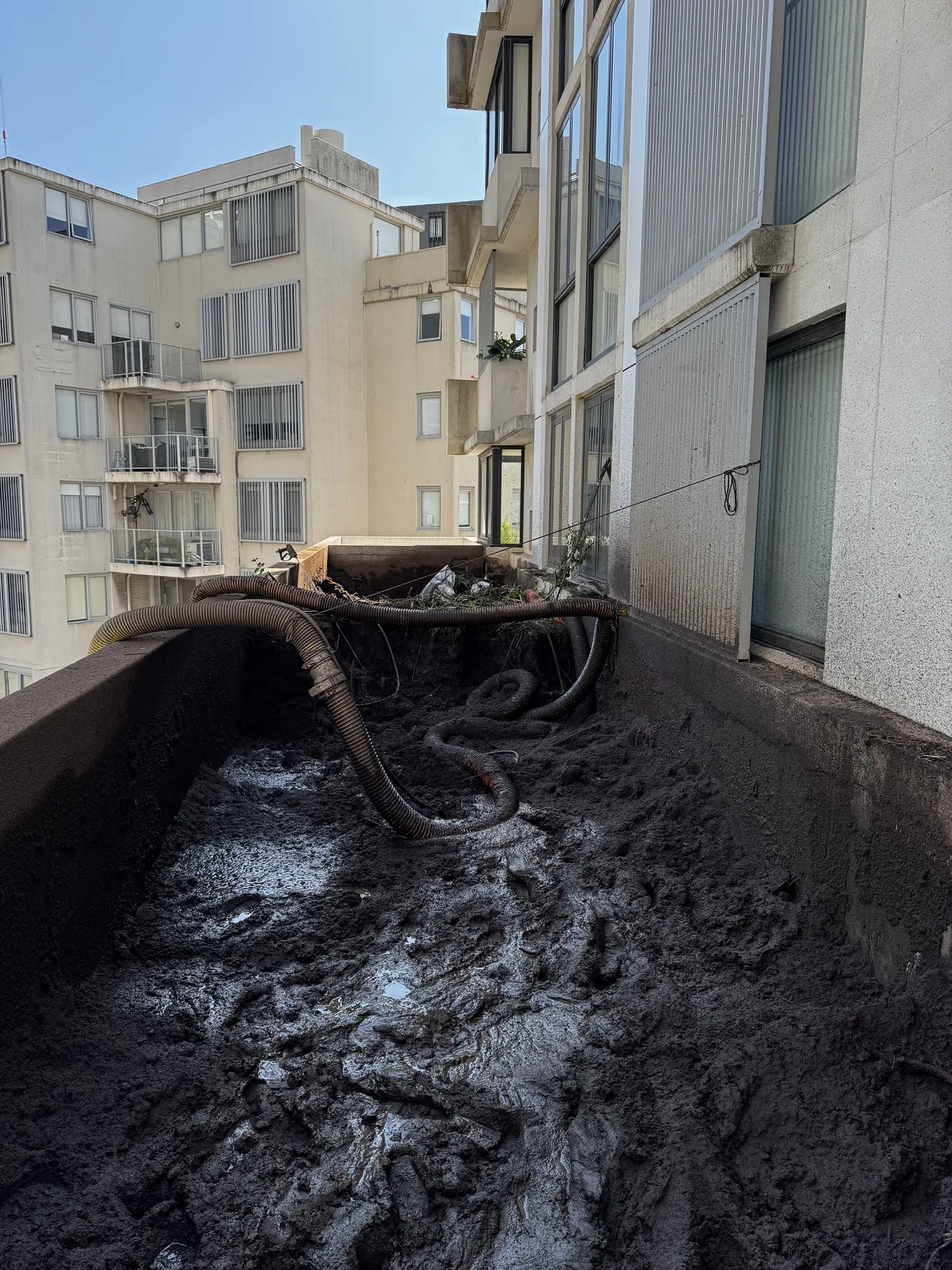
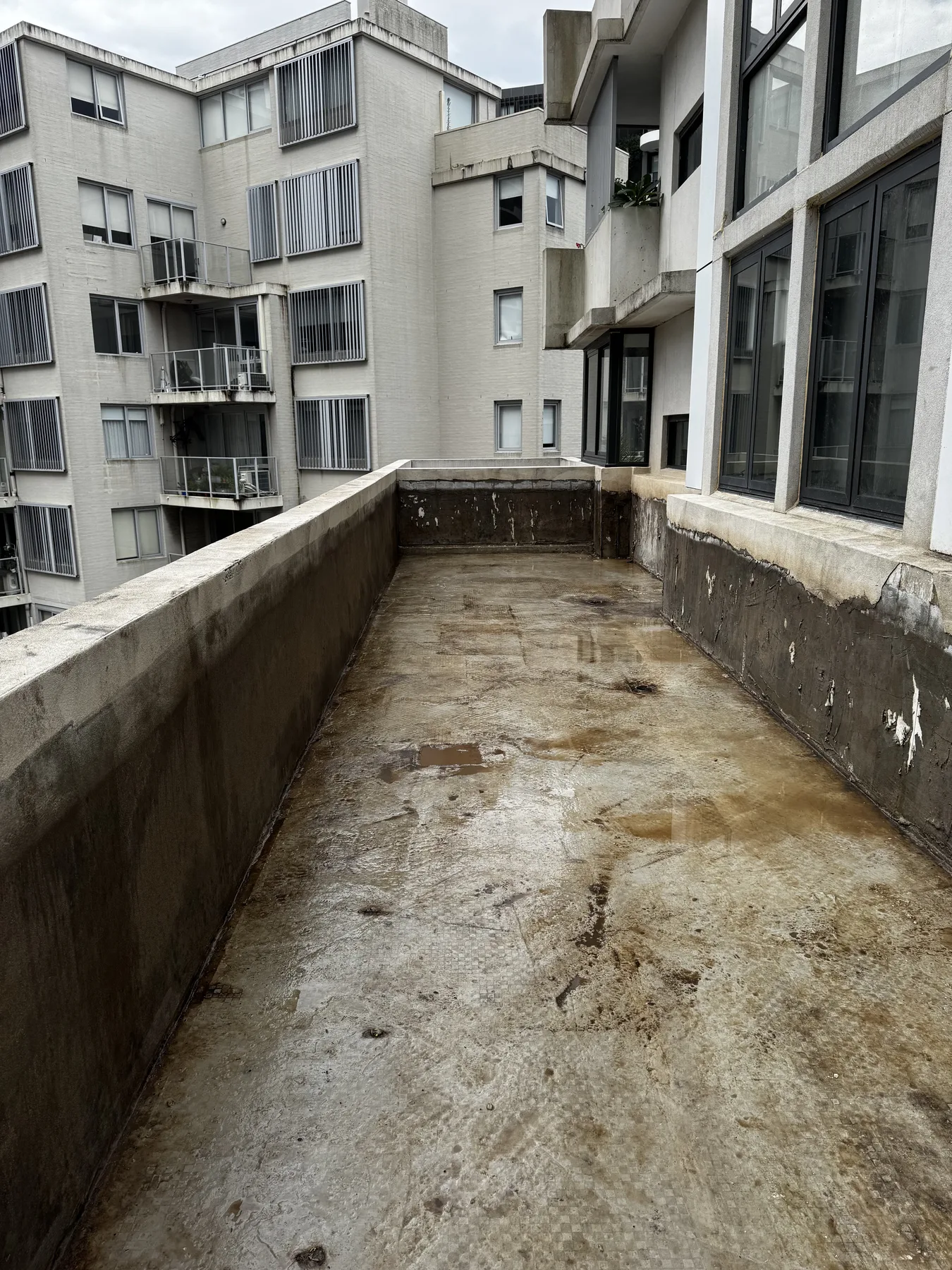
The photograph below that is the same bed emptied back to the slab. The old soil line is still visible as a stain on the retaining walls, and the surface is still damp. That is a normal finish for this kind of clean-out, and it is the point at which waterproofing, drainage or replanting work can start.
Jobs like this are exactly where a vac truck makes sense.
What affects the price of a soil removal job
Two planter boxes can look identical in photos and price very differently, because the cost sits in the access and the material rather than the dirt itself. A long hose run through a tight loading area is a different job from a truck parked at the kerb.
- Truck location, and whether the site has a legal loading position.
- Distance and complexity of the hose run.
- Approximate volume of soil, roots, slurry, or garden waste.
- Whether the material is dry, wet, compacted, or mixed.
- Disposal requirements and tip runs.
- Working-hour limits for strata, commercial, or high-traffic sites.
We do not publish a rate per cubic metre, because the number would be wrong for most sites. We would rather look at the photos and give you a figure for your job.
Disposal: where the soil goes, and who is responsible for it
It is worth understanding this part before you book anyone. The NSW EPA states that "those who generate waste are responsible for classifying their waste into one of six waste classes". It also sets out why the classification matters: waste "can only be taken to, and accepted at, a waste facility which is lawfully authorised to receive, re-use and/or dispose of that classification or type of waste".
Councils put the same duty in plainer terms. The Hills Shire Council tells residents that "as the owner of the waste, you may still be held responsible for where it ends up and may have to pay clean-up costs". That is one council's wording. Other Sydney councils set their own rules, so check the one covering your site rather than assuming.
In practice that means telling whoever quotes what the material actually is. Clean garden soil, mixed garden waste, slurry and material from a site with an industrial history are not the same product to a disposal facility, and the difference shows up in the price. If you know of a past use that might have contaminated the ground, say so early.
Where soil removal overlaps with other work
If the soil sits over or near buried assets, the removal method matters for more than mess. SafeWork NSW advises that when excavation work is carried out, you should "get information about the underground essential services that are at the site and at any adjacent areas, before work commences". It then adds a second step: give that information to whoever you engage to do the work.
That is the situation non-destructive digging exists for: removing material around known or suspected services without a blade or a bucket going through them.
A planter box clean-out often involves more than dry soil too. If standing water, blocked drainage, wet sediment, or site run-off is part of the problem, de-watering services and drain clean-out are better planned alongside the soil removal than discovered on the day.
For hardstands, pits, access areas, and residual site build-up, industrial and high-pressure cleaning is usually the follow-on service.
Planning a strata or apartment planter box job
We plan vac truck access around apartment buildings, strata complexes, commercial sites, and tight urban locations across Sydney. If you manage a strata building, apartment complex, commercial property, or rooftop garden, the best time to call is before the job becomes urgent. A short conversation about access, volume, photos, and building restrictions usually settles whether a vac truck is the right fit.
What to send with your enquiry
Photos of the planter box, a rough size or length, access photos, the loading area, building restrictions, and whether the material is wet or dry. Those details decide the right truck, the hose run, and the likely disposal requirements.
Frequently asked questions
Can a vac truck remove soil from a planter box?
Yes. A vac truck can remove soil, wet material, slurry, roots, and loose debris from planter boxes when hose access is possible. It is especially useful for high-rise, rooftop, courtyard, and strata planter boxes where wheelbarrow access is slow, messy, or impractical.
Is vac truck soil removal always the cheapest option?
No. For a small garden bed with simple access, a landscaper, labourer, ute, or skip bin may be cheaper. Vac truck soil removal makes more sense when access is difficult, the material is wet or heavy, the volume is significant, or mess needs to be tightly controlled.
Do you handle soil disposal after the clean-out?
We can vacuum, load, transport, and dispose of suitable material as part of the job. Soil and mixed waste may need to be assessed or classified depending on the site, material type, contamination risk, and disposal facility requirements.
Can you work on strata and apartment buildings?
Yes. We plan vac truck access around apartment buildings, strata complexes, commercial sites, and tight urban locations across Sydney. The key details are truck position, hose run, access points, working hours, water availability, and disposal requirements.
Need soil removed on a Sydney site?
If you need soil removed from a high-rise planter box, a rooftop garden bed, a courtyard, a strata common area, or any hard-access site, send us the details. We will tell you whether a vac truck is the right option or whether something simpler will do.
We work across Greater Sydney, including the Hills District, Western Sydney, Sydney CBD, the Northern Beaches, Eastern Suburbs and Sutherland Shire, as well as Newcastle, Wollongong, the Central Coast and the ACT.
Ready for a straight answer?
Request a quote on your soil removal job
Request a quote with site photos, truck access and hose-run details, or call us if it is urgent.
This article is general information, not a site-specific assessment. How your material must be classified, and which disposal rules apply, depends on the site, the material, and your local council.