
Eire Vacuum Services Blog
Pier Hole Clean-Out: What to Measure, What to Send and What Happens at the Base
Eire Vacuum Services runs operated vac trucks from Box Hill for builders, civil crews and plumbers in Sydney.

The holes are drilled and the inspection or pour is booked. Then you find water, mud or fallen soil sitting in the bottom. The auger’s clean-out bucket has done what it can. This guide is for Sydney builders and contractors who now need the base clean without anyone climbing in.
The short answer
An auger clean-out bucket works well on a dry, firm hole. Once a pier hole holds water, slurry or soil that has slumped off the walls, a vac truck can lift it out from the surface. Nobody goes down the hole. To get it priced, send the number of piers and each diameter and depth. Add whether there’s water in them, where the truck can park, and how far and how high the hose has to run.
Listen to a short summary (1 min 57 s)
A spoken summary of this guide, with captions and a transcript.
Transcript
Dry, wet or slumping: does your pier hole need more than the auger cleaner?
Start by looking down the hole, because the condition of the hole decides the job, not the size of the job.
- Dry and firm. A little loose spoil on the base, walls standing up. The auger’s clean-out bucket or disc is usually all you need.
- Wet. Rainwater, groundwater or drilling water sits in the bottom, often with a soft layer of mud under it. This is the job a vac truck is for.
- Slumping. Soil has fallen off the walls, or the base keeps softening after you clean it. The water and the fallen material both have to come out, and the hole may need attention from whoever designed the footing.
If your holes are dry and firm, you probably don’t need us. Finish them with the auger and save the money. The rest of this guide is for holes in the second and third groups.
Why auger cleaners struggle once there’s water or slurry in the hole
Hole-cleaner buckets are built to lift spoil. Digga, an Australian attachment maker, describes its hole cleaner as removing “spoil from holes after drilling to create a clean and flattened base” (Digga, retrieved 5 November 2026). That’s the right tool for loose, dry soil.
Water changes it. A bucket or disc can’t hold free water, and thin slurry runs straight back off it on the way up. Each pass can also stir the soft layer on the base back into suspension.
A vac truck takes the water, the slurry and the loose material up the same hose and into its tank. The base is left clearer for the next check.
Where the truck stands and how much hose that needs
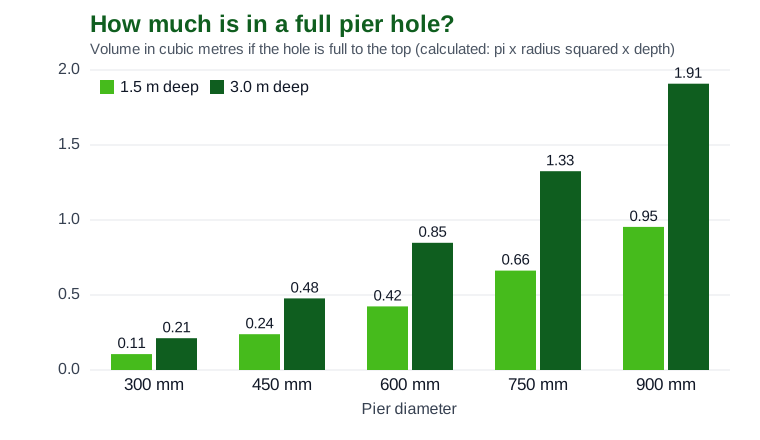
A 600 mm pier that is 1,500 mm deep holds about 0.42 cubic metres if it fills to the top. A 450 mm pier of the same depth holds about 0.24 cubic metres. Even twelve full 600 mm holes come to about 5 cubic metres. At those sizes, the hose run and the access usually shape the job more than the tank size does.
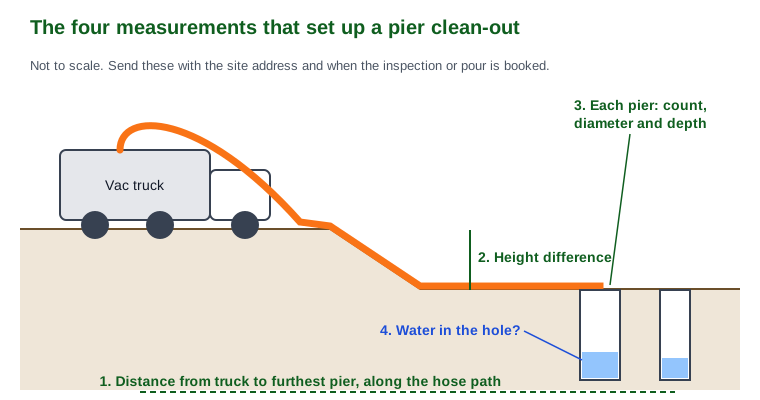
The truck parks where it legally and safely can, and the hose goes from there to every hole. So we need to know how far the furthest pier is from where the truck can stand. We also need to know how much higher or lower the holes are.

Things that change the setup:
- Distance. Measure from the likely truck position to the furthest hole. Follow the path the hose would actually take around fences, buildings and garden beds.
- Height difference. Note whether the holes are above or below the truck, and roughly by how much.
- Access. Gates, kerbs, overhead wires, soft ground, or a school, hospital or occupied site with its own rules for vehicles.
- Spread. Piers spread across a site may need the hose moved several times, which takes time.
If the distance is long, say so up front. It is fine to ask for extra hose as its own quote item. Our guides to planning truck access and hose runs and to the 8,000 L and 10,000 L trucks cover both in more detail.
What the vac truck does at the base of a wet or slumped pier
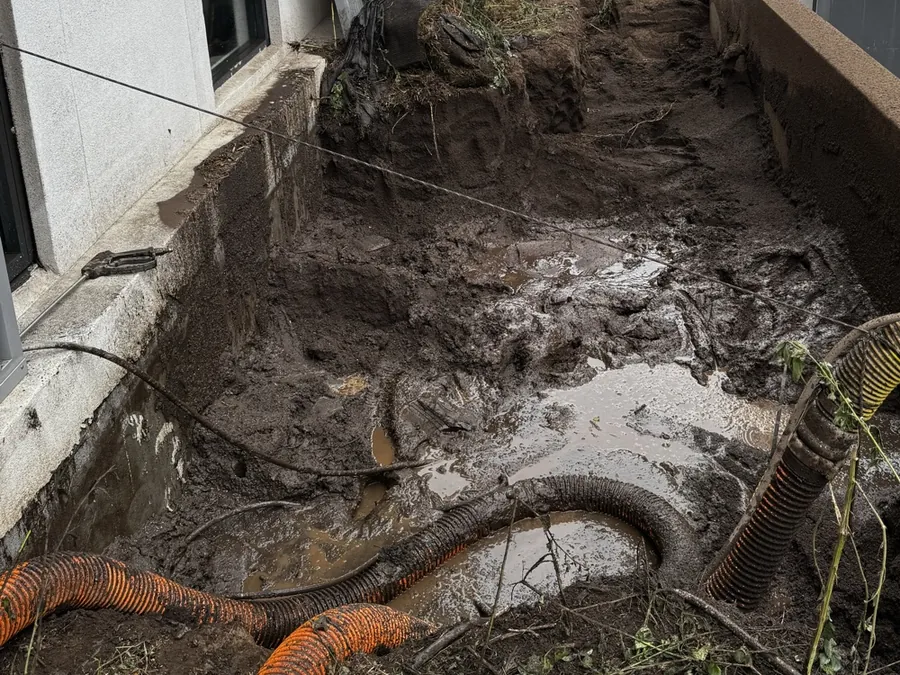
On a pier clean-out, the operator works the suction hose from the surface. Water, mud, slurry and loose material go up the hose into the truck. Where material has packed down, the operator can use water to loosen it so it can be lifted. Nobody needs to go into the hole.
Before starting, we confirm truck access, hose reach, the condition of each hole and the material coming out. That’s why we ask for those details first.
Afterwards, the hole is left clearer for whoever comes next: the engineer, the certifier, the steel fixer or the concreter. If groundwater keeps coming back in, tell us. That can mean timing the clean-out close to the inspection or pour. It can also mean treating it as a de-watering job rather than a one-off clean.
The material leaves site in the truck. If you’re also dealing with spoil or slurry elsewhere on the job, our mud and slurry removal service covers that.
What gets checked before the pour
The clean-out isn’t the finish line. In NSW, a building job has set check points called critical stage inspections. Section 61 of the Development Certification and Fire Safety Regulation 2021 sets them (NSW Planning clause table).
Hornsby Shire Council lists one “after excavation for, and prior to the placement of, any footings” (Hornsby Shire Council, retrieved 6 November 2026). The full list of inspections for your job is in the schedule attached to your Construction Certificate or Complying Development Certificate.
Your engineer’s footing notes set what the base must look like, and whether any water can be left in a hole. Your principal certifier checks it at that inspection. We do not inspect or certify footings. If your notes say the base must be free of water and loose material, that’s what the clean-out is for. If you’re unsure, ask the engineer before the truck is booked.
Open holes are also a fall risk while you wait. SafeWork NSW calls falls into pier holes “a known risk”. It expects you to stop people and vehicles getting near them. Where that is not reasonably practicable, it expects pier hole covers designed by a competent person. It also says fence panels are not rated as covers. Excavating pier holes more than 1.5 metres deep is high risk construction work, which needs a Safe Work Method Statement (SafeWork NSW, 11 February 2021).
The SafeWork NSW Excavation work Code of Practice has more detail. This is general information only. Your Safe Work Method Statement and your engineer decide what applies on your site.
The pier schedule and enquiry to send
This is what lets us price a pier clean-out without guesswork. Most of it you already have from the footing plan.
| Pier or group | How many | Diameter (mm) | Depth (mm) | Water in the hole? | Ground | Distance from truck (m) | Higher or lower than the truck? |
|---|---|---|---|---|---|---|---|
| Example group A | 2 | 600 | 1,500 | Unknown | Unknown | Unknown | Unknown |
| Example group B | 2 | 450 | 1,500 | Unknown | Unknown | Unknown | Unknown |
| Your piers | Your count | Your diameter | Your depth | Yes, no or unknown | Clay, sand, fill, rock or unknown | Your distance | Higher, lower or level |
- How many
- 2
- Diameter (mm)
- 600
- Depth (mm)
- 1,500
- Water in the hole?
- Unknown
- Ground
- Unknown
- Distance from truck (m)
- Unknown
- Higher or lower than the truck?
- Unknown
Example group A
- How many
- 2
- Diameter (mm)
- 450
- Depth (mm)
- 1,500
- Water in the hole?
- Unknown
- Ground
- Unknown
- Distance from truck (m)
- Unknown
- Higher or lower than the truck?
- Unknown
Example group B
- How many
- Your count
- Diameter (mm)
- Your diameter
- Depth (mm)
- Your depth
- Water in the hole?
- Yes, no or unknown
- Ground
- Clay, sand, fill, rock or unknown
- Distance from truck (m)
- Your distance
- Higher or lower than the truck?
- Higher, lower or level
Your piers
The example rows follow the shape of a real enquiry we received. It listed two piers at one diameter and two at another, with depths given and site conditions not yet known. It also asked for extra hose as its own line. “Unknown” is a fine answer; just say so.
Here is how that example reads. The footing plan shows four piers: two at 600 mm and two at 450 mm, all 1,500 mm deep, with site conditions unknown. That is two rows in the schedule. Add where the truck can park and the distance to the furthest pier, and we can work out the setup.
Then add:
- The site address or suburb, and the kind of site (house, school, commercial, civil).
- When the inspection or pour is booked.
- Where the truck can park, and any access rules or height limits.
- Whether the holes are covered or fenced off right now.
- Any questions or site rules about where the water and spoil go after they leave site.
Our contact form asks for your name, phone, email, job address, the service and a message. Paste the schedule into the message. You can also attach photos of the holes or a PDF of the footing plan: up to 5 files, 10 MB in total.
Pier clean-out in Sydney
Send the schedule and we’ll work out the setup
Count, diameters, depths, water, truck position and hose distance. Operated wet hire: the truck, operator, vacuum system and water arrive together.
Questions builders ask about pier clean-outs
Can you pour concrete into a pier hole with water in it?
That is your engineer’s call, not ours. Your footing notes and the inspection decide whether a hole must be dry, and how the concrete goes in. If they need it dry, we can remove the water and slurry before the pour.
How do you get water out of a pier hole?
For small amounts in a firm hole, a pump may be enough. When there is mud, slurry or fallen soil with the water, a vac truck lifts all of it from the surface into its tank. Nobody has to go into the hole.
Who checks the pier holes before the concrete goes in?
In NSW, an inspection after excavation and before footings are placed may be listed as a critical stage inspection for your job. Your principal certifier carries it out, and the builder or owner books it. Your engineer’s notes set what the base must look like.
How far can the hose reach from the truck?
It depends on the site, the height difference and the material, which is why we ask for the distance and levels first. If the run is long, tell us and we will allow extra hose in the quote.
Does the truck come with an operator?
Yes. Every Eire Vacuum Services job comes with the truck, the operator, the vacuum system and the water together.
Ready when your holes are
If your pier holes are wet, muddy or have soil fallen in, call (02) 5023 3473 or send your pier schedule through our enquiry form. We’ll come back to you with the setup and price. For more about the service itself, see pier clean-out in Sydney or vac truck hire in Sydney.
Talk to Eire Vacuum Services
Pier holes not ready for the pour?
Call or send the job details. We’ll confirm truck access, hose reach and the material before the truck is booked.