
Eire Vacuum Services Blog
Vac Truck Site Access: Parking, Hose Runs and Working Space
Samantha manages enquiries, bookings, and the day-to-day business side at Eire Vacuum Services.
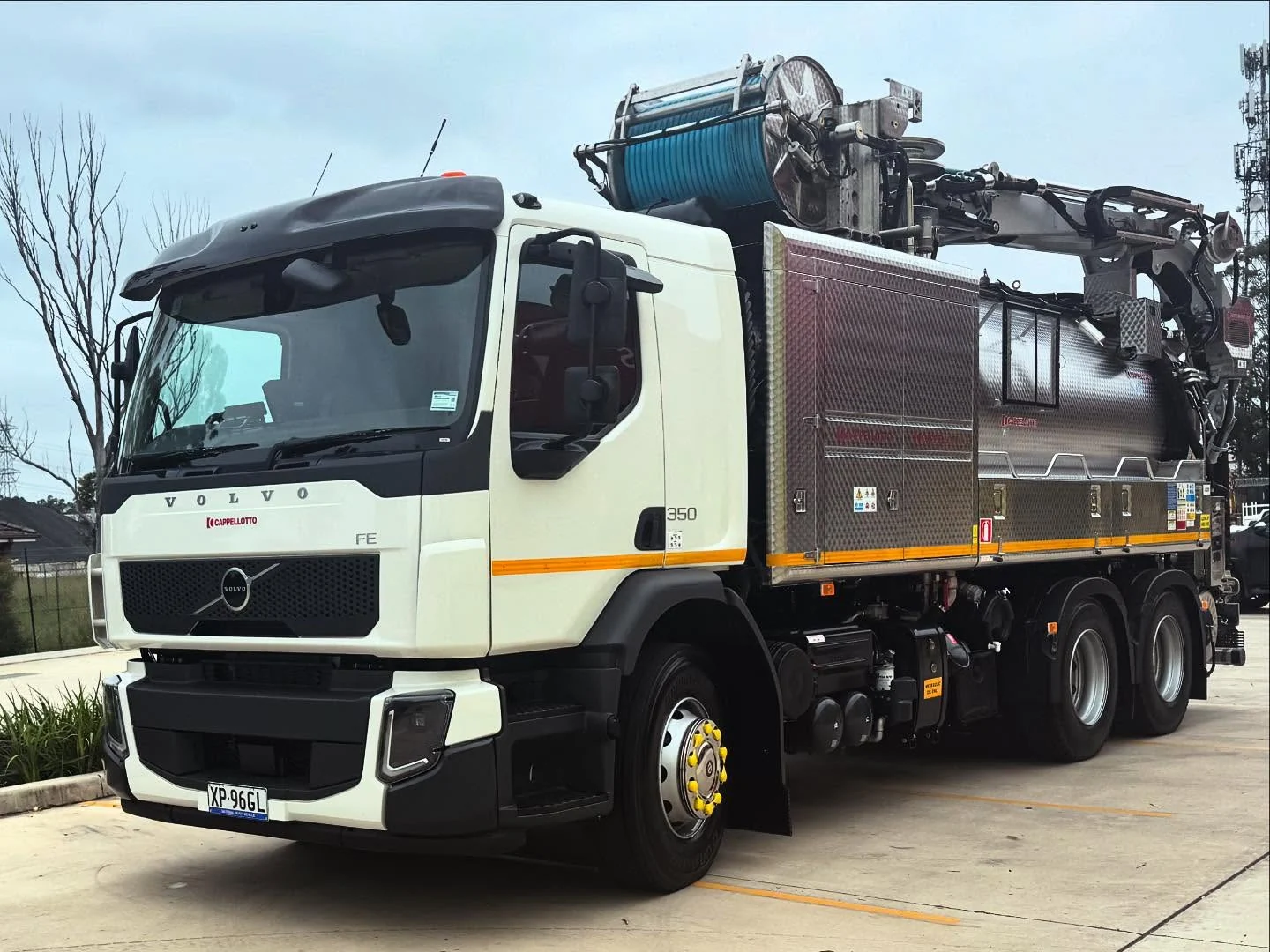
Vac truck site access comes down to three separate checks, and they have to be answered in this order: where can the truck legally and physically stand, how far is it from that position to the work, and what has to be clear around the work itself. Most site access problems are not discovered at the work point. They are discovered at the kerb, at the boom gate, or at the height bar, before the hose has come off the reel.
Key takeaway
A vac truck is not one machine, it is a machine plus a distance. The truck stays where it can legally stand and the hose travels the rest of the way. Everything that makes a job slow, or impossible on the day, is a constraint on one of those two things.
The three checks, in the order you can actually perform them
You do not need to know what the truck weighs to answer these. You need to know what your own site does.
- **Check 1, position.** Is there somewhere the truck can legally and physically stand, on site or on the street, and does standing there need a permit?
- **Check 2, distance.** From that position, how far does the hose have to travel to reach the work, measured along the route it can actually take?
- **Check 3, working space.** At the work point, is there room for the operator, the hose, the exclusion zone and the wet material coming out?
A job fails on the day when one of these was assumed rather than checked. Usually it is the first one.
Check 1: where can the truck legally and physically stand?
The physical envelope is bigger than most people picture
Heavy vehicle dimensions are set by the Heavy Vehicle National Law, not site by site. On height, the National Heavy Vehicle Regulator states plainly that "The height limit for a heavy vehicle is 4.3 metres", with higher limits reserved for specific vehicle types such as a "vehicle built to carry cattle, horses, pigs or sheep" and a "double-decker bus".
On width, the NHVR states that "The width limit for a heavy vehicle is 2.5 metres unless it is: a Safer Freight Vehicle or a combination that includes a Safer Freight Vehicle". The Safer Freight Vehicle package, in the NHVR’s words, "includes an increase to the overall width limit from 2.50 to 2.55 metres for new trucks fitted with a number of specific safety features". The NHVR adds that "The increased width limits only apply to rigid or cab chassis trucks and prime movers, NOT trailers or buses."
On length, the NHVR’s general access vehicle definition covers "A rigid motor vehicle built mainly as a load carrying vehicle (maximum length 12.5m)."
Those are national legal maximums, not the specification of any one truck. Their practical use to you is as a planning ceiling. If your entry, driveway or basement cannot take a vehicle approaching those figures, that is a conversation to have before booking rather than on the morning.
The number that decides a basement or a covered carpark is not on any of those pages. It is the clearance posted on your own height bar, and it is usually the lowest figure the truck will meet all day. Read it and send it. A boom gate, a canopy, a first-floor overhang or a low branch on the approach can each stop a truck that would otherwise fit the space beyond them.
On site or on the street
If the truck can stand inside the property, most of the permit question disappears. Loading and unloading on site is the normal expectation. The City of Sydney puts it this way for construction work: "Generally, all loading and unloading associated with construction will be accommodated within the development site. If this is not feasible, we may consider an on-street works zone."
When the truck has to stand on the road, two separate approvals can apply, and they are not alternatives to each other.
A works zone from the council. The City of Sydney describes it as follows: "An on-street works zone, sometimes known as a construction loading zone, is a section of road where vehicles involved in construction work can stop."
The timeframe is the part that catches people out. The City states a processing period of "6 to 8 weeks", and that once approved, "the works zone will be installed 14 days after the receipt of the security deposit, kerbside use fees and notification to nearby properties." If your site is not in the City of Sydney, confirm the process and the timeframe with the council that covers it rather than assuming these figures carry across.
A Road Occupancy Licence from Transport for NSW. Service NSW puts the trigger in one sentence: "You need a Road Occupancy Licence to conduct activities like fixing pot holes or construction work that is likely to have an impact on the operations of an arterial road". Confirm the current lead time with the issuing authority rather than assuming, because it is set by them and not by your contractor.
The trigger is road space, not the character of the street. If the truck stands entirely within the property, neither approval is in play. Once it occupies a live traffic lane, a classified road or a clearway, the approval becomes the job’s critical path rather than a formality attached to it.
| On-street works zone | Road Occupancy Licence | |
|---|---|---|
| Who issues it | The council. Figures here are the City of Sydney’s. | Transport for NSW, via Service NSW. |
| What triggers it | Construction loading that cannot happen inside the site. | Work "likely to have an impact on the operations of an arterial road". |
| Published lead time | "6 to 8 weeks" to process, then installed 14 days after fees and notification. | Set by the issuing authority. Confirm it with them. |
| If the truck stands on site | Not in play. | Not in play. |
Traffic and pedestrians past the truck
Standing legally is not the same as standing safely. SafeWork NSW states the duty directly: "Employers have a duty to ensure traffic is appropriately managed on their site." It is equally direct about who may perform the control work, stating that "Workers must have the SafeWork NSW Traffic Control Work Training Card if they work in traffic control."
That matters to the access question because it converts a parking problem into a resourcing problem. A truck standing across a footpath in a busy street may need controls, and controls need certified people. Deciding that on the morning is what turns a two-hour job into a day.
Ground, gradient and surface
The last part of Check 1 is what the truck stands on rather than where. A loaded vacuum truck is heavy, and it gets heavier as it works, because the material it recovers stays on board until it is disposed of. Soft ground, a recently laid surface, a suspended slab, a basement deck, a septic or tank lid, or a steep crossover can each rule out a position that looks fine on a plan. Gradient also affects how safely hoses can be run and handled from that position.
Check 2: how far is it from that position to the work?
What a hose run actually is
The hose run is the distance the suction hose has to travel from the truck to the work point, measured along the route it can physically take. It is not the straight line on a site plan. It is around the building, through the gate, up the stairs, past the planter, and along whatever path the hose can be safely handled on.
This is the single variable that most often separates two jobs that look identical. On an exposure job, the hose run is the line item that moves the estimate most. A service forty metres from the nearest legal truck position is a slower job than the identical exposure at the kerb, and one photograph of the access answers that question before anybody drives anywhere.
What lengthens a run beyond its measured distance
Distance is the headline, but it is not the whole cost of a run. These add handling time to the same number of metres:
- **Bends and corners.** Each change of direction is somewhere the hose has to be managed rather than simply laid.
- **Vertical rise.** Stairs, embankments, retaining walls and level changes between the truck and the work.
- **Finished surfaces.** Tiled lobbies, timber decks, lawns, paving and painted line marking all need protection, which means laying and lifting protection as well as hose.
- **Doorways and shared paths.** A route through a building or a common area may only be usable at certain times, or may need a person stationed on it.
- **Live traffic or pedestrians crossing the route.** A hose across a path is a hazard that has to be managed for as long as it is there.
None of this makes a job impossible. It makes a job longer, and it is far cheaper to know before the truck is booked than after it has arrived.
Which truck fits is decided here, not by capacity alone
Tank size matters less to an access question than most people expect. The two trucks Eire Vacuum Services runs, at 8,000L and 10,000L, differ in capacity, but a service exposure produces a fraction of the spoil a clean-out does, so on this kind of work the tank is seldom what limits the job. Position is. The smaller unit is the easier fit on kerbside, laneway and constrained civil sites; the larger one is the better choice where bulk material is coming out, or where the same visit also has to take away water or slurry. Where the job is bulk soil removal rather than exposure, the trade-off is a different one again, and we set it out in our comparison of a skip bin against a vac truck for soil removal.
Check 3: what has to be clear around the work point?
Getting the hose there is not the same as being able to work there. Three things need room at the far end.
Room for the operator and the hose. Someone has to stand at the work point and handle a heavy hose for the duration. A pit in the middle of a stacked laydown area, a planter box hard against a parked car, or a trench with material heaped on both sides all need clearing first.
An exclusion zone. Whatever separation the site requires between the work and everyone else stays required while the vacuum truck is there. If the work point is on a walkway, in a carpark aisle, or beside an active loading dock, that separation has to come from somewhere.
Somewhere for wet material to go. Hydro excavation creates wet material. It leaves the ground as slurry, and it goes into the truck rather than onto the surface, but the surface around the work still gets wet and the material still has to be contained on the way. Sensitive finishes, drainage that must not be contaminated, and areas the next trade needs clean are all worth flagging in advance rather than discovering together.
Water supply belongs in this check as well. Hydro excavation uses water, the truck carries a finite amount of it, and whether there is a usable supply on site changes how a longer job is planned.
Get the access confirmed before the truck is booked
Tell us where the truck would stand and how far the hose has to go
Send the site photos, the proposed truck position and the hose-run distance, and we can tell you whether it works and what has to be arranged first. Call 02 5023 3473, or send it through the contact page.
Do you need a special licence to operate a vacuum truck?
If you are hiring the truck, no. The licence obligation sits with whoever drives it, not with the site that books it.
Which class that driver needs is set by the vehicle, and in NSW the licence classes are defined by gross vehicle mass and axle count. NSW defines a Light Rigid licence as covering "rigid vehicles with a GVM of more than 4.5 tonnes, but not more than 8 tonnes". A Medium Rigid licence covers "rigid vehicles with 2 axles and a GVM of more than 8 tonnes". A Heavy Rigid licence covers "rigid vehicles with 3 or more axles and a GVM of more than 8 tonnes".
So the honest answer to the question is that a vacuum truck needs a heavy vehicle licence of the class matching that particular truck’s GVM and axle count, and the contractor is the one who holds it. There is no separate "vacuum truck licence" in that list, because the list is about driving the vehicle.
Operating the equipment on site is a different question again, covered by the operator’s own training and by whatever the site itself requires, such as the traffic control card noted above where control work is involved. It is a fair thing to ask a contractor to evidence. It is not something the client needs to hold.
What are the limitations of hydro vac trucks?
The limits worth knowing are the ones that change your planning, not the ones that read like a disclaimer.
- **The truck does not move to the work, the hose does.** Everything in Check 2 is the limitation. A long or awkward run is the cost of a position you cannot improve.
- **Tank capacity is finite.** Recovered material stays on board. On a large removal job the constraint is not how fast the truck can lift material, it is how many trips it takes and how far the disposal point is.
- **Water is finite too.** The truck carries its own water, and a long job may depend on a usable supply on site.
- **The spoil comes out wet.** That is the method working as intended, but it changes containment, surface protection and disposal from an afterthought into part of the plan.
- **There is no honest single depth figure.** Workable depth depends on ground conditions, access, hose setup, service risk, excavation shape and the site’s safety controls. Anyone quoting one number for every site is quoting a brochure, not your job.
- **It confirms a point, not a run.** Exposing a service confirms where it is at the place you exposed it. Plans and locator marks guide the work, and visual exposure is what actually confirms depth and position.
None of that is a reason to reach for a different method near buried services, which is precisely what non-destructive digging exists to avoid. It is the reason the access conversation happens before the booking rather than after it.
What to photograph and measure before you call
This is the whole article turned into something you can do in five minutes.
- The route from the street or entry point through to the work area, not only a close-up of the material.
- A realistic proposed truck position, photographed from where the truck would stand.
- Driveway width and gate clearance.
- The posted height clearance on any bar, boom gate or carpark entry on the route.
- Loading zones, parking restrictions and clearway times on the frontage.
- Gradients and level changes between the truck position and the work.
- Overhead restrictions such as canopies, awnings, cabling and branches.
- Any traffic or pedestrian controls already in place, or obviously needed.
- The approximate hose-run distance along the route the hose would take.
- What the material is, roughly how much of it there is, and what the next trade needs the area to look like.
Before any job is booked we confirm the same list every time: truck size, hourly rate, estimated time, hose run, safety controls, disposal costs, disposal depot distance and waste type. Sending the access detail up front is what lets that list be answered accurately instead of provisionally.
Where we work
We work across Greater Sydney, including the Hills District, Western Sydney, the Sydney CBD, the Northern Beaches, the Eastern Suburbs and the Sutherland Shire, as well as Newcastle, Wollongong, the Central Coast and the ACT.
Frequently asked questions about vac truck site access
The questions we are asked most often about getting a truck to the work, answered in one place.
What is the meaning of vac truck?
It is shorthand for a vacuum truck. The overlapping names are covered in our guide to vac truck, vacuum truck and sucker truck terms. For access, what matters regardless of the label is the truck’s height, width and length, where it can legally stand, and how far the hose has to run from there.
How much money can you make with a vacuum truck?
That is an owner-operator question about running a truck as a business, not a site access question, and it is not something we can answer for someone else’s operation. If you are hiring rather than buying, the useful equivalent is what changes the cost of your own job. That comes down to the truck size, the time on site, the hose run from the truck position to the work, any traffic control the position requires, and the disposal cost, depot distance and waste type.
Can a vac truck work in a basement carpark?
It depends entirely on the posted clearance on the entry, the ramp gradient, and what the deck is rated to carry. The truck usually stands outside or at the entry and the hose runs in. Send a photo of the height bar and the ramp, and the distance from there to the work.
Do I need a permit for the truck to park on the street?
Sometimes. If the truck can stand on site, usually not. If it needs to occupy road space, a council works zone or a Transport for NSW Road Occupancy Licence may apply depending on the road and the work. The City of Sydney states a "6 to 8 weeks" processing period for a works zone, so it belongs in your programme rather than in your morning.
Plan the access, then book the truck
Vac truck site access is not one question, it is three. Where the truck can stand, how far the hose has to go from there, and what has to be clear at the other end. Answer those before booking and the job runs to time. Leave them to the day and the truck can be sitting at the kerb while somebody looks for a permit.
If you want the truck itself, the operator and the equipment in one visit, that is vac truck hire in Sydney. If you are still working out whether a vacuum truck is the right machine at all, our guide to what a vacuum truck does covers the common Sydney job types. If the question behind the access is really what the job will cost, what affects vacuum truck hire rates in Sydney sets out the variables.
Send the access detail and get a straight answer
We will tell you whether it works and what needs arranging
Photos from the street through to the work area, a realistic truck position, and the hose-run distance are enough. Call 02 5023 3473, or request a quote through the contact page.