
A stormwater pit is a below-ground chamber. It collects rainwater and site run-off and passes it into the piped drainage network. You will find them at low points across a property or a street: at the base of a driveway, beside a car park, along a boundary, or built into a civil or commercial site drainage design. If water is pooling near one, draining slowly, or the pit itself is visibly full of leaves, sediment, or debris, that is usually what people mean by stormwater pit cleaning.
Key takeaway
Most stormwater pit problems are one of two things. Either the pit itself has sediment, debris, or a partial blockage sitting in it, or the pipe running away from the pit is blocked further down the line. The first is a straightforward clean-out. The second usually needs jetting to clear the line, sometimes paired with vacuum recovery to take the loosened material away.
What a stormwater pit actually does
A stormwater pit is a collection point, not a treatment system. Water enters through a grate or an inlet and drops into the chamber. It then continues out through a connected pipe toward the street network, a detention system, or an outfall, depending on how the site was designed. Because it sits at a low point and often has an open grate, it also collects whatever the run-off carries with it.
- Rainwater and hardstand run-off from roofs, driveways, and paved areas.
- Sediment washed off exposed or disturbed ground nearby.
- Leaves, litter, and general debris that reach the inlet grate.
- On active sites, spoil or wash water from nearby work if controls are not in place.
None of that is unusual. It is what the pit is designed to intercept before the water continues into the piped network. The issue is only when enough has built up that the pit stops doing its job properly.
Stormwater pit vs soak well: what is the difference?
Both are below-ground drainage structures, but they solve different problems.
| Stormwater pit | Soak well | |
|---|---|---|
| Structure | Sealed chamber | Open base, perforated sides |
| Where the water goes | Out through a connected pipe | Soaks into the surrounding ground |
| Common where | A property connects to a piped drainage network | On-site infiltration is the design choice |
| Typical maintenance | Sediment and debris clear-out | Same, plus checking the base has not clogged with fines |
That difference is why they turn up in different situations. A stormwater pit is common wherever a property connects to a piped drainage network, including most urban and suburban sites. A soak well is more common where a formal connection is not practical. It is also used where the site approval requires water to be retained and released into the ground rather than sent straight to the network. Which one a structure is comes down to how it was built and connected, so it is worth confirming rather than assuming from the surface fittings alone.
Who is responsible for keeping a stormwater pit clear?
Across NSW council areas, drainage components on private property are the property owner's responsibility to maintain. Wollondilly Shire Council states the position plainly: "You must maintain your roof water drainage, stormwater pipes, gutters, downpipes, stormwater inlet pits and any other components of your approved drainage system on your property in good condition and in compliance with any Council requirements." Note that inlet pits are named explicitly.
From the boundary out, the public network is managed by the local council. Councils may also maintain drainage infrastructure inside a registered easement on private land, where that is needed to keep the system working. Which of those two categories a given pit or line falls into varies by property and by council. If there is any doubt, confirm it with the relevant council.
How to remove dirt from a deep backyard sump pit
A backyard sump pit is the same kind of structure by another name: a below-ground chamber that collects water at a low point. For a straightforward build-up of dirt, leaves, and sediment in the base of a pit, the practical options are a manual clean-out for a shallow, accessible pit, or vacuum removal for a deeper pit or a heavier volume of settled material. Vacuum loading suits this job well. It lifts wet sediment and debris out through a hose, so nobody has to get into a confined chamber. The material leaves in the same visit.
- A shallow pit with light leaf litter or debris can often be cleared by hand.
- A deeper pit, or one with settled sediment and standing water, is a vacuum job.
- If water is not draining away at all after the pit itself is clear, the blockage is further down the line, not in the pit.
When jetting is the right tool, and when vacuum recovery is needed too
If the pit is clear but water still is not draining, the problem is usually in the connected pipe. Root intrusion, a partial collapse, or built-up sediment further along the line are the common causes. That is a jetting job, not a pit clean-out. High-pressure jetting clears the line by breaking up and flushing the blockage through to a point it can be managed.
The two often go together. Jetting a line loosens material and pushes it toward an access point or the pit itself. That loosened material and water then needs to be removed rather than left to resettle. That is where vacuum recovery comes in alongside jetting. Jetting clears the line, and vacuum recovery takes the loosened water and sediment away in the same visit. That combination is the approach we use for stormwater and site-drainage clean-outs.
- Pit itself is full or blocked, water pools at the surface: pit clean-out, usually vacuum.
- Pit is clear but the line will not drain: jetting, and vacuum recovery for what it dislodges.
- Recurring blockage at the same point: worth checking whether the line has a structural fault rather than just clearing it again.
Not sure which one you need?
Send the details and we will tell you straight
Send a few photos of the pit, how full it is, and whether water is draining at all, and we can tell you honestly whether it is a straightforward clean-out or a jetting job.
Working out which job you actually have
The order matters, because clearing a pit that was never the blockage is a wasted visit.
- Look in the pit. If it is full of sediment, leaves or debris and the water above it is not moving, the pit itself is the problem.
- Clear the pit, then watch the water. A pit clean-out that fixes it was a pit clean-out.
- If the pit is empty and the water still will not drain away, the blockage is in the connected line, not the chamber.
- Jet the line, and recover what the jetting dislodges rather than leaving it to resettle in the pit you just cleared.
- If the same point blocks again within months, treat it as a possible structural fault in the line rather than another clean-out.
What a pit clean-out involves on site
Most of the cost and most of the surprises on this kind of job come from access and disposal, not from the pit itself.
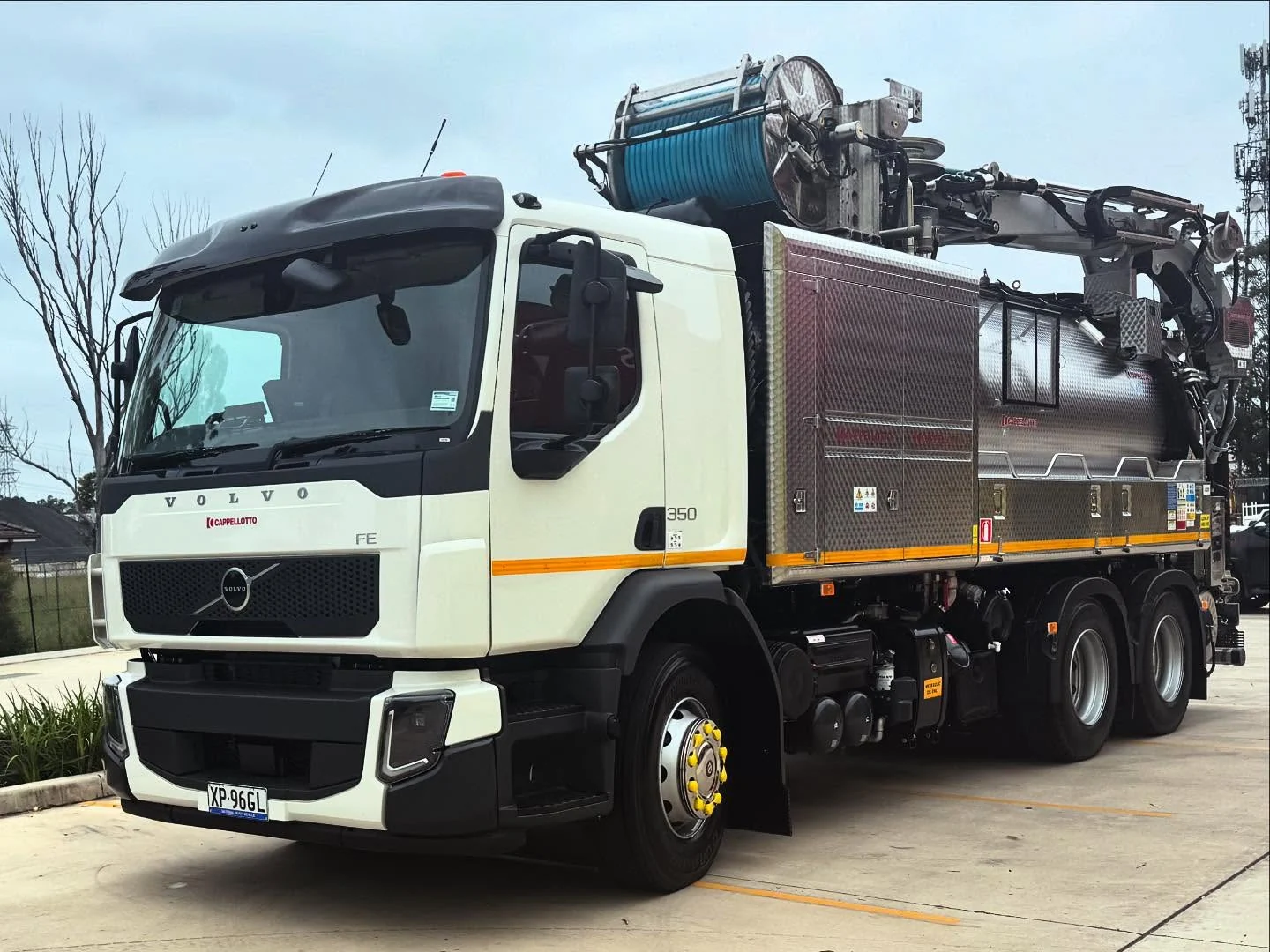
We run 8,000L and 10,000L vacuum trucks. The 8,000L unit suits civil, commercial, drainage and tight-access work. The 10,000L adds capacity for larger site clean-outs, water removal, slurry and disposal runs. Which one fits is decided by two things: how much wet material is coming out, and how close the truck can get to the pit.
Before a job is booked we confirm the truck size, hourly rate, estimated time, hose run, safety controls, disposal costs, disposal depot distance and waste type. Disposal depot distance is the easiest of those to overlook. Recovered pit material is wet and heavy, and it has to go to an appropriate facility, so a site a long way from a suitable depot costs more to clear than an identical pit closer in.
That is also why photographs are more useful to us than a description. A photo of the pit, the grate, and where a truck could park answers the access and hose-run questions in one go.
Sediment, construction sites, and what should not go into a stormwater pit
Stormwater drainage is designed to carry rain, not building waste. That is the whole point of the NSW EPA position that the drain is just for rain: what enters a stormwater pit is generally not treated before it reaches a creek, river or beach. On active construction and renovation sites, sediment-laden run-off and wash water reaching a stormwater pit is one of the more common site-management issues.
The practices that prevent it are not informal habits. They are set out in the NSW guideline Managing Urban Stormwater: Soils and Construction, Volume 1 (Landcom, 4th edition, 2004), the document the industry calls the Blue Book. In its publisher's own words it exists to "provide support for councils and industry to reduce the impacts of land disturbance activities on waterways by better management of soil erosion and sediment control". That same guidance carries a direct warning, again in its own words: "Heavy fines may be imposed if soil, earth, mud, clay, concrete washings or similar material wash, or are placed in a position where they are likely to be washed, into stormwater drains."
So a pit that keeps clogging with sediment during works is usually telling you something about the site, not just about the pit. Repeat clogging is a signal that the erosion and sediment controls upslope need attention, and clearing the pit again without fixing that is a recurring cost rather than a repair.
Our read on this, stated as an inference rather than measured data
The two sources above point at the same conclusion from opposite directions. The Blue Book treats sediment control as a design obligation on the site, and the EPA treats the drain as something that discharges untreated. Put together, a stormwater pit that fills repeatedly during works is functioning exactly as intended: it is catching material that the site's own controls should have stopped further upslope. That reframes a repeat clean-out from a maintenance cost into a signal, which is why the first question we ask on a repeat callout is what changed upslope, not how full the pit is.
If the site also has standing water beyond what a pit clean-out covers, that overlaps with de-watering rather than a routine pit clean-out.
Where we work
We work across Greater Sydney, including the Hills District, Western Sydney, Sydney CBD, the Northern Beaches, Eastern Suburbs and Sutherland Shire, as well as Newcastle, Wollongong, the Central Coast and the ACT.
Related services
If the job is really a blocked or slow-draining line rather than a full pit, our drain cleaning service covers that directly. Where a site clean-out involves more than one drainage asset, or general site and surface cleaning alongside it, that overlaps with our industrial cleaning work.
Frequently asked questions
Can you cover a stormwater pit in your backyard?
Generally no. Covering or paving over the grate blocks the pit from collecting run-off as designed and can push water somewhere it should not go. If the pit is in an inconvenient spot, it is worth checking what it connects to before changing anything around it.
How do you remove dirt from a deep backyard sump pit?
A shallow pit with light debris can often be cleared by hand. A deeper pit, or one with settled sediment and standing water, is better handled with vacuum removal, which lifts the material out through a hose without anyone entering the chamber.
What is the difference between a stormwater pit and a soak well?
A stormwater pit is a sealed chamber that collects water and passes it on through a connected pipe. A soak well has an open base so the water it collects can soak into the surrounding ground instead of being piped elsewhere.
What is the purpose of a stormwater pit?
It collects surface water and run-off before it continues into the piped drainage network, keeping water off hardstand and low-lying ground in a controlled way rather than letting it pool or find its own path.
Got a stormwater pit that needs clearing?
Send a few photos of the pit, how full it is, and whether the water is draining or just sitting there. We can give you a straight read on whether it is a simple clean-out or a jetting job before you book anything.
Ready for a straight answer?
Request a quote on your stormwater pit
Request a quote with site photos, truck access and hose-run details, or call us if it is urgent.
This article is general information, not a site-specific assessment. Whether a structure on your property is a stormwater pit or a soak well, and who is responsible for maintaining it, depends on how it was built, connected, and approved, and on your local council's rules.
References
NSW EPA, The drain is just for rain. Landcom, Managing Urban Stormwater: Soils and Construction, Volume 1, 4th edition (2004), published by NSW Environment and Heritage. Wollondilly Shire Council, stormwater drainage responsibilities.